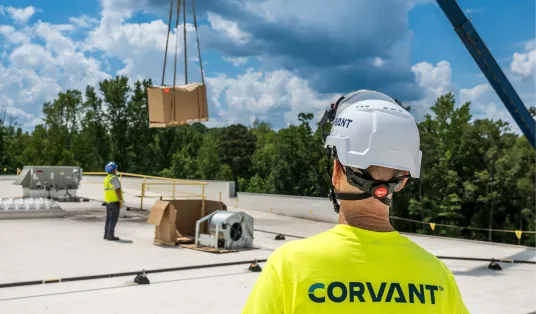
In mission-critical facilities such as hospitals, data centers, and advanced manufacturing plants, a planned maintenance program catches failures before they interrupt operations.
Why Does Plumbing Maintenance Matter in Mission-Critical Facilities?
In a mission-critical facility, a plumbing failure is an operational event, not a facilities inconvenience. A hospital depends on safe, reliable water and steam for patient care. A data center depends on water and drainage systems that support cooling infrastructure. An advanced manufacturing plant may run process water and drainage tied directly to production.
That is why commercial plumbing maintenance in these buildings runs on a schedule, not on complaints. A planned program finds slow leaks, corroding fittings, or failing valves before they become problems. Waiting for a visible failure means fixing it on the system’s terms.
Corvant has supported mechanical and plumbing systems since 1962, with field teams across more than 20 states in the Southeast. Our Service & Maintain teams work alongside in-house facility and maintenance staff. The checklist below reflects how we approach planned maintenance in buildings where downtime is not an option.
How Often Should Each Commercial Plumbing Check Happen?
Most commercial plumbing checks fall into four intervals: daily or weekly walk-throughs, monthly inspections, quarterly service, and annual testing. The right interval depends on your building’s occupancy, water use, local code, and how critical each system is to operations.
| Checklist Item | Typical Interval | Who Usually Performs It |
| Visible leaks and water damage | Daily to weekly walk-through | In-house facility staff |
| Floor and sink drain flow | Weekly | In-house facility staff |
| Water pressure | Monthly | In-house staff or plumbing technician |
| Valves, including emergency shut-offs | Monthly to quarterly | Plumbing technician |
| Grease traps | Every 1 to 3 months | Plumbing or pumping contractor |
| Corrosion and limescale | Quarterly | Plumbing technician |
| Pipe insulation | Quarterly to semi-annually | Plumbing technician |
| Water heaters | Inspect quarterly; flush annually | Plumbing technician |
| Water quality | Per facility water management plan | Qualified testing provider |
| Backflow prevention devices | At least annually, or as local code requires | Certified backflow tester |
Treat these intervals as a starting point. A planned maintenance program should set final frequencies for each system based on an assessment of the actual building.
The 10-Point Commercial Plumbing Maintenance Checklist
Each item below explains what to check, what a problem looks like, and why it matters in a facility where downtime is not an option.
1. Check Water Pressure
Water pressure in a commercial building should generally sit between 40 and 80 psi, and it can vary from floor to floor in a healthy system. Measure it by attaching a gauge to a fixture and opening it fully. Pressure that drifts outside that range can signal a failing pressure-reducing valve, a hidden leak, or a supply issue, and high pressure accelerates wear on fittings and equipment.
2. Find and Repair Leaks Early
Leaks rarely announce themselves. Look for water stains on walls and ceilings, pooling near pipes and fixtures, and mold or mildew, which can point to an unseen leak. In a hospital or data center, a slow leak near sensitive equipment or patient areas is a priority repair, not a backlog item.
3. Inspect Water Heaters
Check water heaters for external leaks and rust, flush them annually to remove sediment, and replace the anode rod when it is depleted. Follow your facility’s water management plan for storage and delivery temperatures.
4. Look for Corrosion and Limescale
Inspect exposed pipes for rust, wear, and blue or green discoloration, which can indicate corrosion. Check fixtures for limescale buildup. Catching corrosion during a quarterly inspection lets you address it in a planned repair instead of an emergency shutdown.
5. Test Valves, Especially Emergency Shut-Offs
Confirm that every valve operates fully, prioritizing emergency shut-off valves. A shut-off valve that has seized from years without use cannot isolate a failure when it matters most. Exercising valves on a schedule keeps them ready.
6. Test Drains for Blockages
Check that sink and floor drains move water at a steady rate. Slow or blocked drains create sanitation and health hazards, and in a commercial kitchen or lab they can back up into occupied space.
7. Test Backflow Prevention Devices
Backflow preventers keep contaminated water from flowing back into the potable supply. Most jurisdictions require testing at least once a year by a certified backflow tester, with results filed with the local water authority. Keep devices free of debris so they open and close properly.
8. Clean and Pump Grease Traps
Grease traps capture fats, oils, and grease before they build up in the drain system. In a commercial kitchen, including hospital food service, they typically need cleaning and pumping every 1 to 3 months, depending on volume.
9. Check Pipe Insulation
Missing, wet, discolored, or deformed insulation can indicate a leak underneath it. Confirm that insulation thickness suits the pipe size and fluid temperature, and that outdoor runs have weather and UV protection in place.
10. Test Water Quality
Regular water quality testing confirms the building’s supply is safe and potable. Testing may include chemical, microbial, and pH checks. In healthcare facilities, testing should follow the facility’s documented water management program.
Planned Maintenance vs. Emergency Response: Why You Need Both
A commercial plumbing maintenance checklist reduces failures, but it cannot eliminate them. Mission-critical facilities need two things from a plumbing partner: a planned maintenance program that finds problems early, and an emergency response that restores systems fast when something fails anyway.
Planned maintenance is the scheduled side. It covers the inspections, testing, and service intervals in the checklist above, documented so your team knows what was checked, when, and what was found. Corvant’s preventive maintenance programs are built around this kind of recurring schedule.
Emergency response is the unscheduled side. When a critical system failed at AdventHealth Celebration, Corvant mobilized within hours to restore the hospital’s steam system. In a healthcare facility, that speed is the difference between a contained repair and a disruption to patient care. Our 24/7 emergency service is part of the same Service & Maintain relationship, so the team that maintains your systems is the team that responds when they fail.
How To Put This Checklist To Work in Your Facility
Start by comparing this checklist against what your team already inspects, and note any item without a set interval or owner. Those gaps are where unplanned failures usually start. Next, decide which checks stay in-house and which need a licensed plumbing partner, especially valve service, backflow testing, and water heater maintenance.
For facilities where downtime is not an option, the most reliable approach is one partner across both planned maintenance and emergency response. Corvant’s Service & Maintain teams build planned maintenance programs around each facility’s commercial plumbing systems, then stay on call when something fails.
Talk with our Service & Maintain team about a plumbing maintenance program for your facility
FAQs
How often should commercial plumbing be inspected?
Commercial plumbing should be checked at several intervals at once: daily or weekly visual walk-throughs, monthly or quarterly inspections of most components, and certified backflow testing at least annually. Final frequencies depend on the building, its use, and local code.
Who should perform commercial plumbing maintenance?
In-house facility staff can handle routine visual checks and drain monitoring. Licensed plumbing technicians or certified testers should perform valve service, water heater maintenance, corrosion repair, and backflow testing.
Is commercial plumbing maintenance different in a hospital or data center?
Yes. In mission-critical facilities, plumbing systems support patient care, cooling infrastructure, or production, so inspection intervals are tighter and documentation matters more. These facilities also need a partner who can respond to emergencies around the clock.